In the field of maritime transport and international logistics, one of the fundamental elements for the movement of goods is the container. Within this system, there are different models regarding container usage and ownership. One of them is the SOC container, a term frequently used in import and export operations.
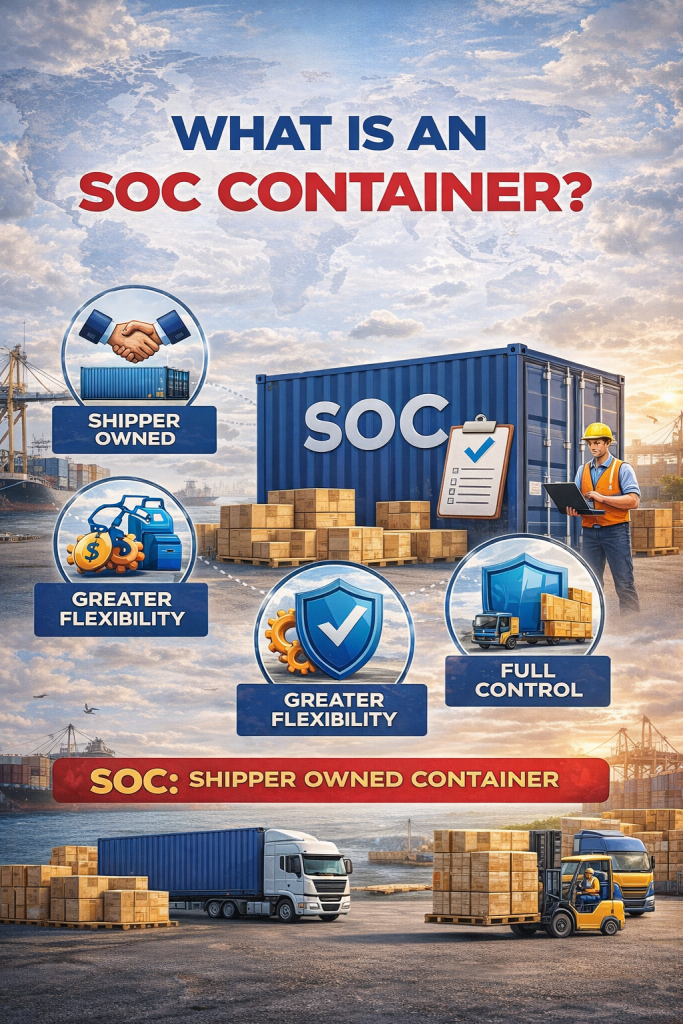
An SOC container stands for “Shipper Owned Container.” This means that the container used to transport the cargo does not belong to the shipping line, but rather to the customer itself, the exporter, the importer, or a company acting on their behalf.
In simple terms, the container is an asset owned by the shipper and used as part of the logistics operation to transport goods.
Container Ownership
The main characteristic of an SOC container is its ownership. In this case, the container belongs to:
- The shipper (exporter or importer)
- A third-party company providing containers for logistics operations
The container may have been:
- Purchased by the company
- Acquired for a specific logistics project
- Provided by a specialized container supplier
Once available, the container becomes part of the transport chain used to move goods internationally.
Although the container does not belong to the shipping line, it can still be transported by the carrier during the maritime journey.
Use Within the Logistics Operation
When an SOC container is used in a logistics operation, the process usually follows these steps:
- Container availability
The shipper provides the container that will be used for the shipment. - Cargo loading
The goods are loaded at the point of origin, which may be:- A warehouse
- A logistics center
- An industrial facility
- Transport to the port
The loaded container is transported by truck or rail to the port of departure. - Port operations
At the port terminal, the container is:- Registered
- Handled by port equipment
- Loaded onto the vessel
- Maritime transport
During the sea journey, the container travels alongside other containers on the ship.
Even while it is part of the ship’s cargo, the ownership remains with the shipper or the company that supplied the container.
After arrival at the destination port, the container is unloaded and continues through the standard logistics process until the final delivery point.
Identification of an SOC Container
Containers used in international maritime transport, including SOC containers, have a unique identification numberthat allows them to be tracked across the global logistics system.
This identification follows international container standards.
A container typically displays the following information:
- Owner code
- Serial number
- Check digit (control code)
- Technical container specifications
These markings allow the container to be registered, monitored, and tracked within:
- Shipping company systems
- Port terminals
- International logistics documentation
Role of SOC Containers in International Transport
SOC containers are part of the global containerized cargo transport system used in international trade.
They are integrated into the logistics chain connecting:
- Manufacturers
- Exporters
- Transport companies
- Ports and terminals
- Final receivers
Within this system, the container functions as a standardized cargo unit, allowing goods to be transported safely and efficiently across multiple transport modes, such as:
- Trucks
- Trains
- Ships
The concept of the SOC container is especially common in international maritime transport, where containers are essential for moving large volumes of goods between countries and continents.
Conclusion
An SOC (Shipper Owned Container) is a container used in maritime transport whose ownership belongs to the shipper or to a company providing the container for the logistics operation.
This type of container is used to load and transport goods within the international logistics chain, following the same operational processes as other containers during loading, transport, and delivery.
Within the global container transport system, the SOC container represents a model where the container itself forms part of the shipper’s logistical resources, while still being transported through the standard infrastructure of international shipping.