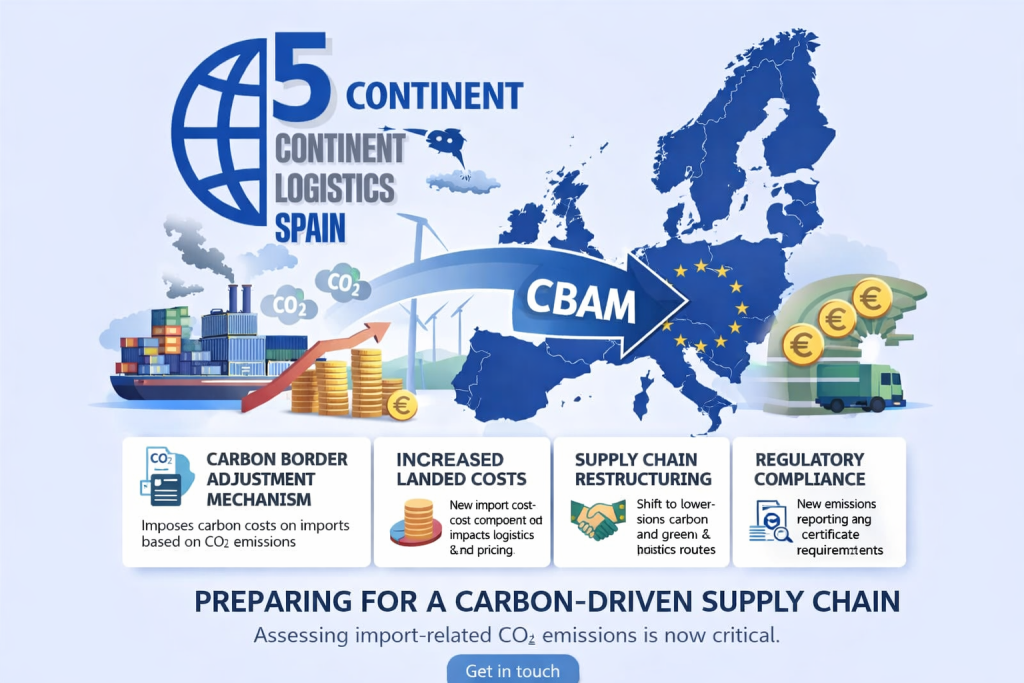
The cost of importing into Europe has changed forever
For years, importing goods into Europe was driven by predictable variables such as freight rates, customs duties, and transit times. Today, a new factor is reshaping global trade: carbon emissions now have a price.
With the implementation of the Carbon Border Adjustment Mechanism (CBAM), companies must rethink how they calculate landed costs and structure their supply chains. What is currently a reporting requirement will soon become a direct financial obligation.
Businesses that fail to anticipate this shift risk increased costs, reduced margins, and loss of competitiveness.
What is CBAM and why it matters for logistics
The Carbon Border Adjustment Mechanism is a regulatory initiative introduced by the European Union to apply a carbon cost to imported goods based on their embedded CO₂ emissions.
It initially targets carbon-intensive industries such as:
- Steel
- Aluminum
- Cement
- Fertilizers
- Electricity
- Hydrogen
The goal is to prevent carbon leakage and ensure fair competition between EU-based producers and international exporters.
For logistics professionals, this represents a major shift. Supply chains are no longer evaluated only on cost and speed—carbon footprint is now a key decision-making factor.
How CBAM works in practice
CBAM is being implemented in phases, allowing companies time to adapt:
Emissions reporting (current phase)
Importers must declare the emissions generated during the production of imported goods.
Carbon pricing alignment
These emissions are linked to the EU Emissions Trading System (ETS), which determines the carbon cost.
CBAM certificates (from 2026–2027)
Companies will be required to purchase certificates equivalent to their reported emissions, turning carbon into a direct cost.
The impact of CBAM on global logistics operations
Increased landed costs
Carbon pricing will become a new component of total import costs, affecting:
- Pricing strategies
- Profit margins
- Procurement decisions
Supply chain restructuring
Companies are expected to shift towards:
- Lower-emission suppliers
- Regions with stricter environmental standards
- More transparent production processes
Operational complexity and compliance
CBAM introduces new administrative challenges:
- Emissions data collection
- Supplier coordination
- Regulatory reporting
- Audit readiness
Acceleration of sustainable logistics
The regulation will indirectly drive:
- Route optimization
- Modal shifts (rail, short sea shipping)
- Investment in greener transport solutions
CBAM as a strategic opportunity
While CBAM introduces regulatory pressure, it also creates opportunities for companies willing to adapt.
Organizations that integrate carbon into their logistics strategy will benefit from:
- Improved cost control
- Stronger supplier selection criteria
- Enhanced brand positioning through sustainability
- Greater transparency across the supply chain
Logistics providers now play a key role in supporting clients through this transition, moving beyond operations into strategic advisory.
Preparing for a carbon-driven supply chain
The future of logistics will be defined by three key variables: cost, speed, and carbon.
Companies that proactively adapt their sourcing strategies, data systems, and logistics models will be better positioned to compete in an increasingly regulated environment.
CBAM is not just an environmental regulation—it is a structural transformation of global trade.
At 5 Continent Logistics Spain, we help companies navigate regulatory changes like CBAM while optimizing their international supply chains.
Are you ready to understand how CBAM will impact your operations?
Get in touch with our team to build a more efficient, compliant, and future-ready logistics strategy.