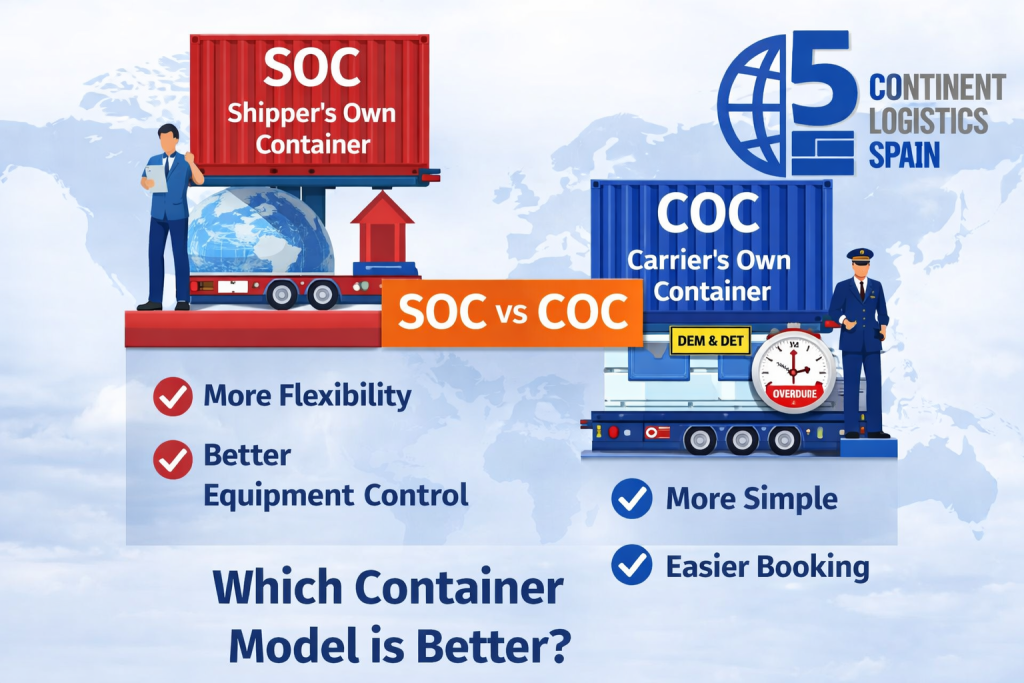
In today’s global logistics environment, choosing the right container ownership model can directly impact cost efficiency, flexibility, equipment availability, and transit reliability. For importers, exporters, and freight forwarders, understanding the operational difference between SOC (Shipper’s Own Container) and COC (Carrier’s Own Container) is no longer just technical knowledge — it is a strategic supply chain decision.
As international trade becomes more volatile, with port congestion, equipment shortages, demurrage costs, and shifting freight rates, selecting the right working system can make the difference between a smooth shipment and an expensive disruption.
This is why understanding SOC vs COC logistics is essential for any company moving cargo internationally.
What is COC (Carrier’s Own Container)?
A COC container is equipment owned and managed by the shipping line or ocean carrier.
This is the most common container system in international ocean freight, especially for FCL shipments.
Under this model:
- The carrier provides the container
- The carrier controls availability
- The container must be returned to the designated depot
- Charges such as detention and demurrage may apply if deadlines are exceeded
For most shippers, this is the simplest and most standardized method because the carrier manages the full equipment cycle.
When COC works best
COC is usually the best option when:
- The shipment follows a standard port-to-port route
- Delivery timelines are predictable
- Container return depots are easily accessible
- The shipper wants minimal operational complexity
Easy real-world example
Think of COC like renting a car from an airport rental company.
You use the vehicle for your trip, but you must return it to the agreed location and within the allowed time. If you keep it longer, extra fees apply.
That is exactly how detention and demurrage in COC logistics work.
What is SOC (Shipper’s Own Container)?
A SOC container is owned or leased directly by the shipper, consignee, NVOCC, or freight forwarder, rather than the carrier.
This model gives the cargo owner much more control over equipment usage, routing flexibility, and return conditions.
With SOC shipping, the container does not need to be returned to the carrier’s depot, which can significantly reduce:
- Detention charges
- Empty repositioning costs
- Delays caused by depot restrictions
- Equipment shortages in origin markets
This system is increasingly popular in project cargo, one-way shipments, inland destinations, and regions with poor container repositioning balance.
When SOC works best
SOC is highly effective when:
- Shipping to remote inland locations
- Moving cargo to countries with limited empty container depots
- Handling long storage periods
- Managing special equipment or project logistics
- Seeking cost predictability
Simple example anyone can understand
Imagine instead of renting a car, you own your own van.
You can use it for the delivery, keep it parked at the destination, or use it again for another route without worrying about returning it to the rental office.
That freedom reflects the operational flexibility of SOC containers.
SOC vs COC: Direct Logistics Comparison
The decision between SOC and COC should always be based on route economics, equipment control, cargo type, and destination complexity.
1) Cost structure
- COC: Lower initial setup, but higher risk of detention/demurrage costs
- SOC: Higher initial container acquisition cost, but better long-term cost optimization
For long dwell times, SOC often becomes more economical.
2) Flexibility
- COC: Fixed carrier rules and return deadlines
- SOC: Greater freedom for storage, inland use, and one-way projects
3) Equipment availability
During periods of container shortage, SOC can protect shippers from carrier limitations.
This became especially valuable during the global supply chain crisis, when equipment availability became one of the biggest pain points in logistics.
4) Operational simplicity
- COC: Easier for standard import/export teams
- SOC: Better for experienced logistics operators needing control
Advantages and Disadvantages
COC Advantages
- Easier to book
- Standardized carrier processes
- No need to source equipment
- Ideal for routine trade lanes
COC Disadvantages
- Exposure to demurrage and detention
- Less control over free time
- Return depot restrictions
- Limited flexibility for inland projects
SOC Advantages
- Better supply chain flexibility
- Reduced extra charges
- Excellent for project cargo and remote deliveries
- Greater equipment control
- Useful during shortages
SOC Disadvantages
- Requires equipment sourcing
- More planning and documentation
- Possible repositioning responsibility
- Better suited for experienced logistics partners
So, Which One Should You Use?
There is no universal winner in the SOC vs COC comparison.
The best choice depends on:
- Cargo type
- Transit time
- Destination infrastructure
- Container dwell time
- Budget sensitivity
- Need for operational control
For standard retail imports into major ports, COC containers are often the most efficient solution.
For project cargo, heavy equipment, long-term storage, inland Africa, Middle East operations, or one-way shipments, SOC containers can unlock significant cost savings and flexibility.
For businesses outside logistics, the easiest way to understand it is this:
COC = convenience
SOC = control
And in modern global freight forwarding, control often translates into lower costs and better resilience.
Final Thoughts: Why This Comparison Matters More Than Ever
As the logistics sector moves toward smarter, more resilient operations, the choice between SOC and COC container systems is becoming a key part of supply chain strategy.
Companies that understand when to apply each model can reduce unnecessary charges, improve cargo flow, and gain a real competitive advantage in international shipping.
At 5 Continent Logistics Spain, we help clients identify the most efficient container management strategy based on their cargo profile, trade lane, and operational goals.
Looking to optimize your next shipment with the right container model?
Our team can help you choose the most efficient SOC or COC logistics solution for your global operations.