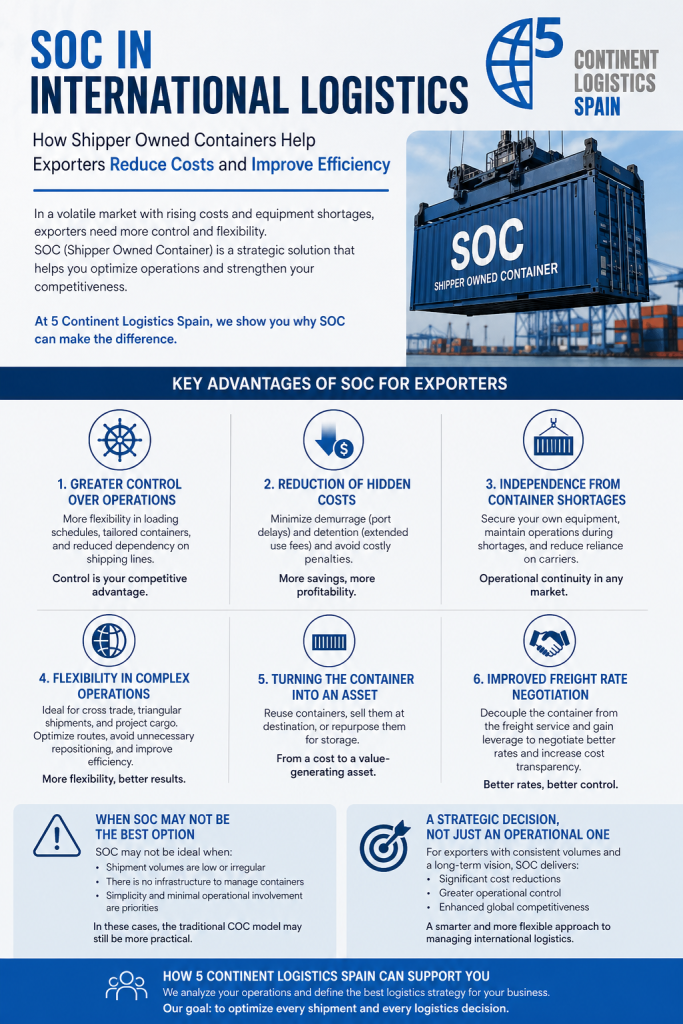
In international trade, every logistics decision directly impacts profitability. In a market shaped by volatile freight rates, equipment shortages, and increasing pressure to optimize costs, exporters are actively seeking more flexible and efficient solutions.
One model that has gained significant traction in recent years is the use of SOC (Shipper Owned Container).
Far from being just an operational alternative, SOC is increasingly seen as a strategic tool for companies looking to gain control over their logistics and reduce costs in maritime transport.
At 5 Continent Logistics Spain, we break down why.
📦 What is an SOC (Shipper Owned Container)?
A Shipper Owned Container (SOC) refers to a logistics model where the container used for shipping is owned or controlled by the exporter or a logistics operator, rather than by the shipping line (COC – Carrier Owned Container).
This seemingly small difference fundamentally changes how operations are managed. By separating the container from the freight service, SOC allows for greater flexibility, cost transparency, and operational control.
🚀 Key Advantages of SOC for Exporters
1. Greater Control Over Logistics Operations
Using SOC containers gives exporters more direct control over their supply chain.
This results in:
- Increased flexibility in loading schedules
- Ability to tailor containers to specific cargo needs
- Reduced dependency on carrier equipment availability
In today’s unpredictable logistics environment, control is a competitive advantage.
2. Reduction of Hidden Costs in Maritime Transport
One of the biggest challenges in export logistics is not the visible costs—but the hidden ones.
SOC helps minimize two critical charges:
- Demurrage (port storage delays)
- Detention (extended container usage fees)
Since the container is not tied to carrier return conditions, exporters gain flexibility and avoid costly penalties.
3. Independence from Container Shortages
Recent global supply chain disruptions have highlighted a key issue: container availability is not guaranteed.
With SOC, exporters can:
- Secure their own equipment
- Maintain operations during shortages
- Reduce reliance on carrier-controlled assets
This independence can be a major strategic advantage in volatile markets.
4. Flexibility in Complex International Operations
SOC is particularly beneficial for complex logistics scenarios such as:
- Cross trade operations
- Triangular shipments
- International project cargo
Because the container does not need to be returned to origin, routes can be optimized, unnecessary repositioning avoided, and overall efficiency improved.
5. Turning the Container into a Strategic Asset
In traditional models, containers are a temporary resource. With SOC, they become an asset.
Exporters can:
- Reuse containers for future shipments
- Sell them at destination
- Repurpose them for storage or other uses
This transforms a cost element into a value-generating component of the supply chain.
6. Improved Freight Rate Negotiation
By decoupling the container from the freight service, exporters gain more leverage in negotiations.
This enables:
- More competitive freight rates
- Greater cost transparency
- Better control over logistics budgeting
In a market where rates fluctuate constantly, this flexibility is crucial.
⚠️ When SOC May Not Be the Best Option
Despite its advantages, SOC is not suitable for every operation.
It may not be ideal when:
- Shipment volumes are low or irregular
- There is no infrastructure to manage containers
- Simplicity and minimal operational involvement are priorities
In such cases, the traditional COC model may still be more practical.
🧠 Conclusion: A Strategic Decision, Not Just an Operational One
The use of Shipper Owned Containers (SOC) should not be seen as a simple operational choice, but as a strategic decision.
For exporters with consistent volumes and a long-term vision, SOC can deliver:
- Significant cost reductions
- Greater operational control
- Enhanced global competitiveness
Ultimately, it represents a smarter and more flexible approach to managing international logistics.
🤝 How 5 Continent Logistics Spain Can Support You
At 5 Continent Logistics Spain, we help exporters analyze their logistics operations and determine whether the SOC model is the right fit for their business.
Our approach is based on expertise, customization, and a clear objective:
👉 to optimize every shipment and every logistics decision.